OpenClaw Just Solved the Biggest Problem with AI Agents
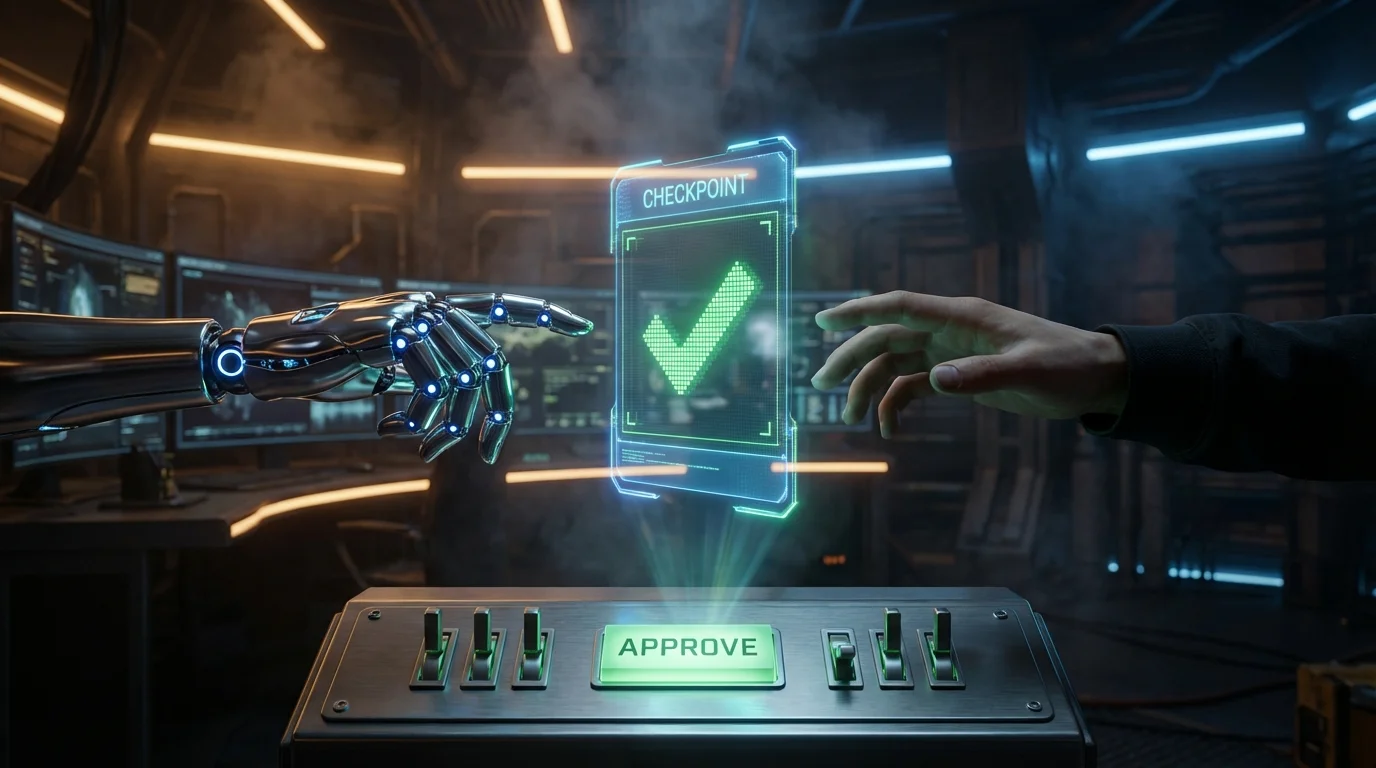
Every conversation about AI agents in the enterprise ends with the same question: "But what if it does something wrong?"
It's the question that kills deals. The question that keeps AI agents locked in pilot programs. The question that forces businesses to choose between two terrible options: let the agent run wild and hope for the best, or babysit it so closely that you might as well do the work yourself.
On March 28, 2026, OpenClaw shipped an answer. Not a workaround. Not a compromise. An actual solution.
They call it supervised autonomy. It's simple: AI agents can work independently, but they pause and ask for approval before doing anything that matters.
Let me show you why this changes everything.
The Problem Nobody Could Solve
Here's how every AI agent conversation has gone for the past two years:
Sales rep: "Our AI can handle your email inbox autonomously!"
Business owner: "What if it sends something wrong to a client?"
Sales rep: "Well, you can review everything before it sends..."
Business owner: "So I still have to read all my emails?"
Sales rep: "...yes."
And the deal dies right there.
The fundamental problem is this: businesses need automation to work without constant supervision, but they can't tolerate the risk of an AI making a mistake on something important.
Previous solutions tried to solve this with better AI models ("trust us, it won't mess up") or elaborate permission systems ("it can only do these 47 specific things"). Neither worked.
Better models still make mistakes. Permission systems are either too restrictive (rendering the AI useless) or too permissive (back to the trust problem).
The industry was stuck.
What Supervised Autonomy Actually Means
OpenClaw's approach is different because it doesn't try to eliminate risk. It manages it.
Here's how it works in practice:
Your AI agent is monitoring your inbox. A customer emails asking for a refund. The agent:
- Reads the email and understands the request
- Checks your refund policy and determines this qualifies
- Drafts a professional response and initiates the refund process
- Stops and asks you: "Ready to send this response and process $247 refund?"
- Waits for your approval
- Executes once you approve
The agent did 90% of the work. It found the email, understood the context, looked up the policy, drafted the response, and prepared the refund. You just make the final call.
That's supervised autonomy. The agent is autonomous (it works independently), but supervised (you approve critical actions).
Compare this to the alternatives:
Fully autonomous: Agent sends the email and processes the refund without asking. Great when it works. Catastrophic when it doesn't. (What if the customer was asking about someone else's order? What if they were just venting and didn't actually want a refund?)
Fully manual: Agent shows you the email and waits for instructions on everything. You have to read the email, interpret the request, decide what to do, tell the agent how to respond. You've saved zero time.
Supervised autonomy: Agent does the thinking, you make the call. You glance at a summary, approve or reject in two seconds, move on with your day.
📬 Get practical AI insights weekly
One email/week. Real tools, real setups, zero fluff.
No spam. Unsubscribe anytime. + free AI playbook.
Why This Is The Enterprise Unlock
Large organizations have been watching the AI agent space with a mix of fascination and terror. They see the potential. They also see the liability.
A startup can afford to let an AI agent experiment. A bank cannot. A two-person company can tolerate a weird email to a customer. A publicly-traded enterprise cannot risk an AI agent making an unauthorized financial transaction.
This is why enterprise AI adoption has been so slow. Not because the technology isn't ready. Because the trust model wasn't ready.
Supervised autonomy changes the equation. Suddenly, you can let an AI agent handle sensitive operations because it can't actually do anything sensitive without approval.
The agent can read contracts, analyze deals, draft responses, prepare transactions, and do all the cognitive work—but the human still holds the trigger.
This is how you get AI into industries like:
- Finance: Agent analyzes transactions and flags suspicious activity, asks approval before freezing accounts
- Healthcare: Agent reviews patient records and suggests treatments, asks approval before updating medical files
- Legal: Agent researches case law and drafts motions, asks approval before filing anything
- E-commerce: Agent handles customer service and processes returns, asks approval before issuing refunds over $X
These are all scenarios where full autonomy is unacceptable, but full manual operation defeats the purpose. Supervised autonomy is the only model that works.
The Implementation Details That Matter
The genius of OpenClaw's implementation is in the details. It's not enough to just ask for approval—you have to make the approval process effortless, or people won't use it.
Here's what they got right:
1. Context-aware approvals
The agent doesn't just ask "approve this?" It shows you why it wants to do something, what it found, and what will happen if you approve. You can make an informed decision in seconds.
2. Configurable thresholds
You decide what needs approval. Maybe the agent can send routine emails autonomously, but needs approval for anything involving money. Or it can handle refunds under $100, but asks about anything higher. The rules are yours.
3. Approval via any channel
The agent can send approval requests wherever you are—Telegram, Discord, email, dashboard. You don't have to context-switch to some special approval interface. It meets you where you work.
4. Timeouts and escalation
If you don't respond within a certain time, the agent can escalate (notify someone else) or default to a safe action (like saving a draft instead of sending). No approval request gets lost.
5. Audit trails
Every approval request and decision is logged. You can see exactly what the agent wanted to do, when it asked, and what you decided. This is critical for compliance and debugging.
What This Means For Your Business
If you've been hesitant about AI agents, supervised autonomy removes your main objection.
Here's how to think about deploying this in your organization:
Start with high-volume, low-stakes tasks. Let the agent handle routine customer inquiries where approval is quick and mistakes are non-critical. This builds trust and teaches the agent your preferences.
Expand to higher-stakes operations gradually. Once you're comfortable with the agent's judgment on simple things, let it tackle more complex scenarios. The approval system means you can experiment safely.
Track your approval patterns. If you're approving 95% of what the agent suggests, you might be able to raise the autonomy threshold. If you're rejecting 50%, the agent needs better training or clearer guidelines.
Use approvals as a training mechanism. When you reject something, tell the agent why. Over time, it learns your preferences and makes fewer requests because it knows what you'll approve.
Set up approval rules that match your risk tolerance. Conservative industries might require approval for almost everything at first. Fast-moving startups might only require approval for actions over certain dollar amounts. The system adapts to you.
The Future of Work Isn't Fully Autonomous
There's been this assumption in the AI world that full autonomy is the goal. That eventually, agents will be so good we won't need to supervise them at all.
I don't think that's right. I don't even think it's desirable.
The best human organizations aren't fully autonomous either. Your employees don't get unlimited authority to make every decision. There are approval processes, spending limits, escalation paths. These aren't bugs in the system—they're features.
Supervised autonomy is the AI equivalent of good management. You hire capable people, give them real authority, let them work independently—but keep the final say on decisions that matter.
OpenClaw understood this. They didn't try to build an AI so smart you never have to think about it. They built an AI that handles the thinking, then asks you to make the call.
That's not a limitation. That's the whole point.
Getting Started
If you're ready to try supervised autonomy, OpenClaw's March 28 update has it built in. The feature is available across all agent types—customer service, email management, data processing, whatever you're building.
The setup is straightforward:
- Define which actions require approval (spending money, sending external messages, modifying data, etc.)
- Set your approval channels (where you want to receive requests)
- Configure timeouts and fallback behaviors
- Let the agent start working
You'll get your first approval request within minutes. Approve it. See how it feels. Adjust your thresholds based on what you learn.
Within a week, you'll have a sense of how much time the agent is saving you versus how much overhead the approvals create. For most businesses, the math works out heavily in favor of the agent—especially as you tune the approval rules over time.
This is the unlock. This is how AI agents move from "interesting demo" to "critical infrastructure."
Not by replacing human judgment. By augmenting it.
The agent does the work. You make the call. Together, you move faster than either could alone.
That's supervised autonomy. That's the future of work.
And as of March 28, 2026, it's not theoretical anymore. It's real. It's shipping. And it's about to change how businesses think about AI.
This is just the basics.
We handle the full setup — AI assistant on your hardware, connected to your email, calendar, and tools. No cloud, no subscriptions. Just message us.
Get Your AI Assistant Set Up