 العربية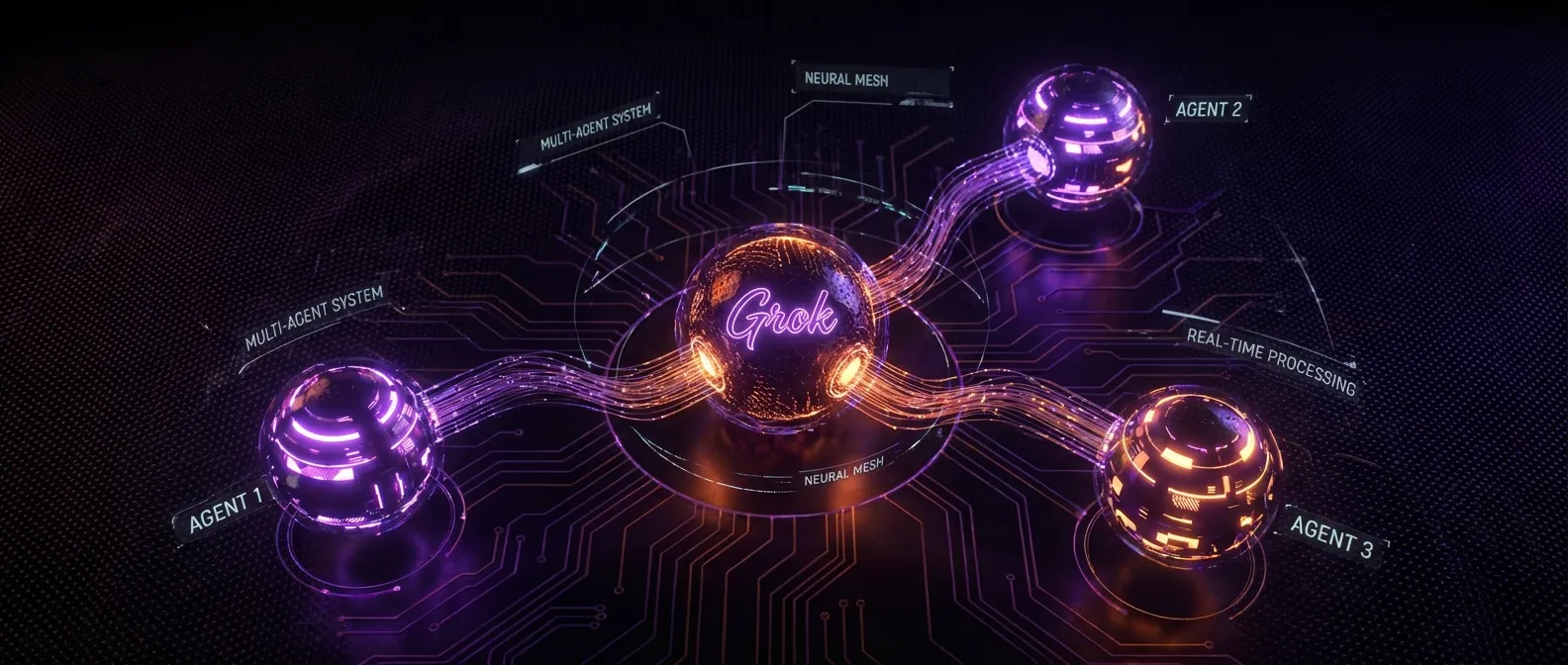
xAI dropped Grok 4.20 in beta on February 17, 2026, and it's not just another model upgrade. It's a fundamentally different approach: four specialized AI agents working together on every task.
Most AI systems use a single model. You ask a question, one brain answers. Grok 4.20 uses four brains, each with a different specialty. Here's how it actually works.
The Four Agents
🎖️ Grok / Captain (The Coordinator)
Captain is the orchestrator. It receives your request, breaks it down into subtasks, assigns them to the right specialist, and synthesizes the final answer. Think of it as the project manager that never sleeps.
🔍 Harper (Research)
Harper handles information gathering. Web searches, data retrieval, fact-checking, source verification. When you ask Grok something that requires current information, Harper does the digging — with deep X/Twitter integration for real-time data.
🧮 Benjamin (Logic & Math)
Benjamin is the analytical engine. Math problems, logical reasoning, data analysis, financial calculations, simulations. When a task requires rigorous quantitative thinking, Benjamin takes the lead.
🎨 Lucas (Creativity)
Lucas handles creative tasks. Writing, brainstorming, content generation, creative problem-solving. When you need ideas, narratives, or anything that requires lateral thinking, Lucas steps in.
How They Work Together
Here's a concrete example. Say you ask: "Analyze Tesla's Q4 earnings and predict next quarter."
- Captain receives the request, identifies it needs research + math + writing
- Harper pulls Tesla's latest earnings data, analyst reports, and relevant X posts
- Benjamin crunches the numbers — revenue trends, margin analysis, growth projections
- Lucas writes it up in a clear, readable format
- Captain reviews, integrates, and delivers the final analysis
The result? xAI claims an order of magnitude improvement over Grok 4 on complex, multi-domain tasks. That's not incremental — that's a fundamentally different capability level.
Multi-Agent vs Single-Agent: What's the Difference?
| Aspect | Single-Agent (Claude, GPT) | Multi-Agent (Grok 4.20) |
|---|---|---|
| Architecture | One model does everything | Specialized models collaborate |
| Strengths | Consistent, predictable | Excels at multi-domain tasks |
| Weaknesses | Jack of all trades | Coordination overhead, loop risks |
| Speed | Fast (one model call) | Slower (multiple agent rounds) |
| Cost | Predictable per-token | Higher (multiple agents running) |
| Best For | Sustained work, coding, writing | Analysis, research, complex queries |
Systems like Claude and OpenClaw use a single model with tools — one powerful brain that can call APIs, search the web, write code. The model handles all reasoning internally.
Grok 4.20 distributes the reasoning across specialized agents. It's like the difference between one brilliant generalist and a team of specialists.
📬 Get practical AI insights weekly
One email/week. Real tools, real setups, zero fluff.
No spam. Unsubscribe anytime. + free AI playbook.
Where Grok 4.20 Shines
- Trading analysis: Benjamin crunches numbers while Harper pulls real-time market sentiment from X. This is Grok's killer app right now.
- Research tasks: Harper's deep web + X integration means Grok has access to information other models don't.
- Math and simulations: Benjamin handles quantitative work at a level that competes with dedicated math models.
- Creative + analytical combos: Need a data-driven blog post? Benjamin analyzes, Lucas writes, Captain polishes.
The X/Twitter Moat
This is Grok's unique advantage that no other AI has: native X/Twitter integration. Harper can search X in real-time, pull trending topics, analyze sentiment from posts, and access information that's not yet on the web.
For traders, researchers, and anyone who relies on real-time information, this is genuinely useful. X is often where news breaks first, and Grok has a direct pipeline.
The Problems (So Far)
It's beta for a reason. Users are reporting several issues:
- Loop issues: Agents sometimes get stuck in coordination loops, passing tasks back and forth without making progress. This is the classic multi-agent failure mode.
- Inconsistency: The same query can produce very different results depending on how the agents collaborate. Single-agent systems are more predictable.
- Speed: Multiple agent rounds mean slower responses, especially for complex tasks where all four agents are involved.
- Cost: Running four models is inherently more expensive than running one. xAI hasn't been fully transparent about pricing yet.
How Does This Compare to OpenClaw?
OpenClaw takes the opposite approach: one powerful model (usually Claude) with a rich set of tools. The model decides what to do, calls the tools it needs, and handles everything in a single reasoning chain.
The advantage? Predictability. Consistency. No coordination overhead. The downside? You're limited to one model's capabilities, even if that model is excellent.
In the future, the best agent systems might combine both approaches — using a single orchestrator that can spin up specialized sub-agents when needed. That's where the agent stack is heading.
The Verdict
Grok 4.20 is the most ambitious multi-agent system we've seen from a major lab. The potential is massive — specialized agents collaborating on complex tasks is probably the future of AI.
But right now, it's a beta. The loop issues are real. The inconsistency is real. For reliable, day-to-day AI work, single-agent systems like Claude are still more dependable.
Watch this space. If xAI solves the coordination problems, Grok 4.20's architecture could become the standard. For now, it's a fascinating preview of where AI agents are heading — and a very good tool for trading analysis and research where its X integration gives it a genuine edge.
This is just the basics.
We handle the full setup — AI assistant on your hardware, connected to your email, calendar, and tools. No cloud, no subscriptions. Just message us.
Get Your AI Assistant Set UpRelated Articles
February 2026 AI Model Releases: Sonnet 5, DeepSeek V4, Grok 4.20 & More
7 major AI models dropping this month. Claude Sonnet 5, DeepSeek V4, Grok 4.20, GPT-5.3 updates — here's what's coming and what it means for your AI assistant.
Samsung Expands Multi-Agent Ecosystem — What It Means for Your Phone
Samsung Galaxy S26 ships with Gemini, Perplexity, and Bixby working together. Here's what the multi-agent ecosystem means for business owners and why it matters.
Claude Opus 4.6 vs Gemini 3.1 Pro: Which AI Model Should You Use? (Feb 2026)
Gemini 3.1 Pro leads intelligence benchmarks by 4 points. Claude Opus 4.6 leads real-world work tasks. One costs half the other. Here's how to choose — or use both.